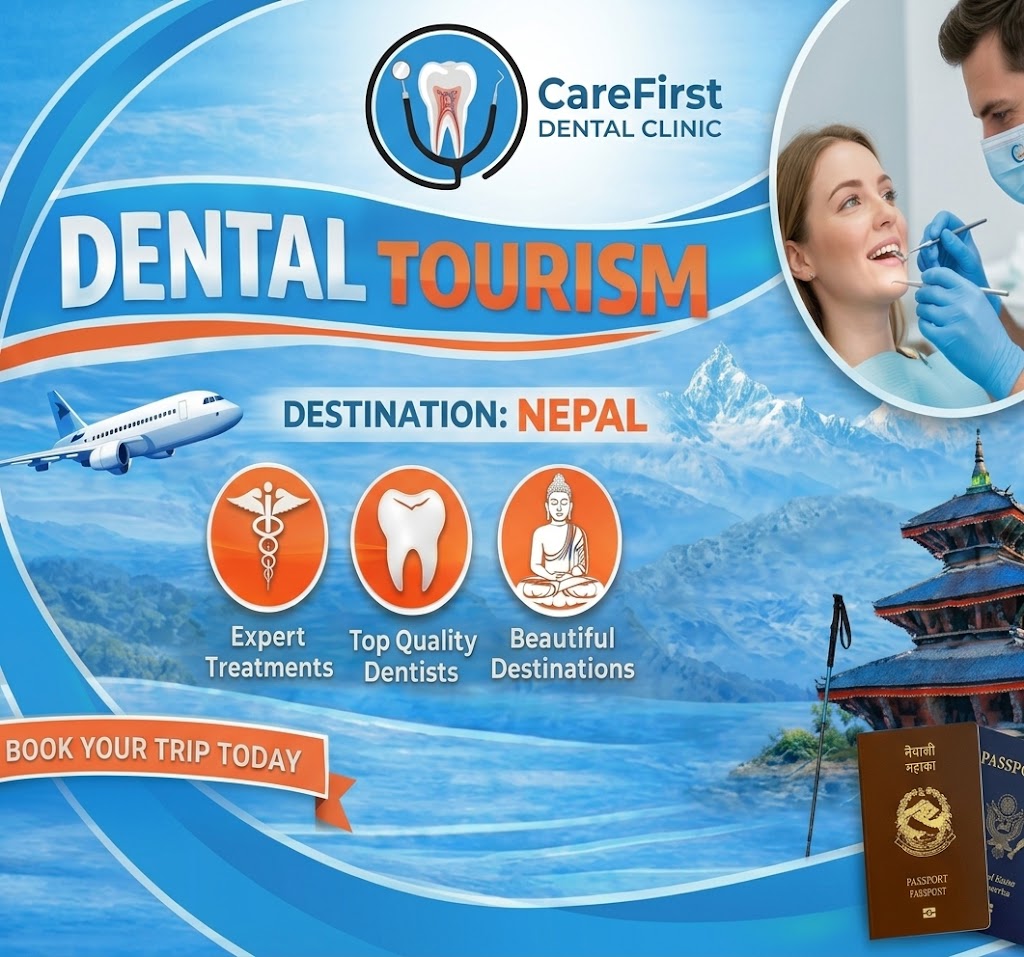
If you've ever winced at a dental quote back home, you're not alone. A single implant or a full set of veneers can easily run into thousands of dollars in the US, UK, Australia, or parts of Europe — and that's before you factor in the wait times. It's this exact frustration that has quietly turned Nepal, a country better known for Everest and ancient temples, into one of South Asia's fastest-growing dental tourism destinations.
This isn't some fringe trend either. Every year, a growing number of patients from the Gulf, Europe, North America, and neighboring India are flying into Kathmandu not just to trek or sightsee, but to get their teeth fixed — and then sticking around to enjoy the mountains once the anesthesia wears off.
Here's a full breakdown of what dental tourism in Nepal actually looks like, why it's growing, what it costs, and what you should know before booking that flight.
What Exactly Is Dental Tourism?
Dental tourism simply means traveling to another country to receive dental treatment, usually because it's significantly cheaper, sometimes faster, and often bundled with the chance to see somewhere new. It's the same idea behind medical tourism in general, except the focus is specifically on oral health — implants, root canals, crowns, veneers, and cosmetic smile work.
Nepal has become part of this global circuit alongside destinations like Thailand, India, Mexico, and Turkey, but with its own distinct pull: dramatic scenery, a slower pace of life, and costs that undercut even some of the other "budget" dental destinations in the region.
Why Nepal, Specifically?
1. The Cost Gap Is Enormous
This is, without question, the biggest driver. The price difference between dental care in Nepal and dental care in Western countries isn't marginal — it's dramatic. A basic filling that costs $300 to $400 in the US or Europe can cost as little as $20 to $40 in Nepal, and a root canal priced around $3,000 in the West often runs closer to $70 to $100 in Nepal.
Implants follow a similar pattern. Industry estimates commonly cited by Nepali clinics put an implant at around $600 in Nepal versus roughly $4,000 in the US, and a crown at around $135 compared to $1,200. Even accounting for flights and accommodation, patients frequently end up saving thousands of dollars on major procedures.
2. The Quality Hasn't Been Sacrificed for the Price
The savings don't automatically mean lower standards. Reputable clinics in Kathmandu have invested heavily in the same equipment used in Western practices — digital X-rays, 3D CBCT imaging, intraoral scanners, CAD/CAM restorations, guided implant surgery, and digital smile design are now fairly standard offerings at the more established practices. Many also use recognized international implant and material brands rather than cheaper alternatives, and clinics increasingly highlight this as a point of trust for international patients.
Dentists themselves are often more internationally trained than people expect. A number of practitioners in Kathmandu hold postgraduate qualifications, implant training, or advanced certifications earned abroad, and some clinics require additional years of residency plus government licensing exams before a dentist is allowed to treat patients.
3. It Comes With a Built-In Vacation
This is the part that makes Nepal different from, say, flying to a dental clinic in a random mid-sized city elsewhere. Patients typically schedule the more intensive appointments early in the trip and leave the later days open for sightseeing — a Kathmandu Valley heritage tour, a short trek in the hills, or simply relaxing before the flight home. Clinics are increasingly used to coordinating around this rhythm, some even partnering directly with tour operators to build the logistics into the treatment plan.
Popular Treatments Among Dental Tourists
Most international patients aren't coming in for a routine cleaning — they're usually tackling something bigger that's expensive back home. The most commonly requested procedures include:
Dental implants – single tooth or full-mouth
Full-mouth rehabilitation – for patients needing extensive, multi-tooth reconstruction
Zirconia crowns and bridges
Porcelain veneers and full smile makeovers
Orthodontic treatment – both traditional braces and clear aligners
Root canal therapy
Clinics that specialize in international patients are generally set up to handle these more complex, multi-visit cases within a compressed timeframe, since most visitors can't realistically stay in the country for months.
Where Most of the Clinics Are
Kathmandu is the clear hub. Private, internationally-oriented clinics tend to cluster in neighborhoods like Lazimpat, Baluwatar, Maharajgunj, and Sanepa — areas that also house much of the city's diplomatic and expatriate community, which has historically demanded higher clinical standards. It's this same expat-and-NGO population that pushed a lot of these clinics toward international-grade equipment and English-speaking staff well before "dental tourism" became a formal marketing category.
Tribhuvan International Airport in Kathmandu connects directly to major hubs including Delhi, Mumbai, Bangkok, Kuala Lumpur, Singapore, Doha, and Dubai, which is a big part of why patients from South Asia, the Gulf, and Southeast Asia find Nepal such a convenient option.
How to Choose a Clinic (This Part Actually Matters)
Not every clinic advertising to foreigners is equally reliable, so a bit of homework goes a long way:
Check the equipment. Look for clinics openly advertising CBCT/OPG imaging, digital scanners, and modern sterilization protocols. Be wary of places that seem to be running on outdated setups.
Verify the dentist's credentials. Years of experience, postgraduate specializations, and international training are worth confirming rather than assuming.
Ask for before-and-after photos of previous implant, veneer, or smile makeover cases.
Read reviews carefully — specifically from other international or diaspora patients, since their expectations and points of comparison are closer to your own.
Confirm the materials being used. Reputable clinics will tell you plainly if they're using recognized brands like Nobel Biocare, Straumann, or 3M rather than unbranded alternatives.
Test their communication before you commit. A clinic that responds quickly and clearly over WhatsApp or email to a pre-treatment inquiry is usually a good sign of how they'll handle you once you're actually there.
Ask about warranties and follow-up care. Implants and crowns should come with some form of guarantee, and it's worth understanding upfront what happens if something needs adjustment after you've flown home.
Look for regulatory registration. Some established clinics are registered and periodically monitored by local health authorities — worth asking about directly.
A Rough Idea of What a Trip Looks Like
While every patient's treatment plan is different, a typical dental tourism trip to Nepal tends to follow a similar shape:
Pre-trip consultation — sharing X-rays, dental history, and photos remotely to get an initial treatment plan and quote.
Comparing clinics and finalizing a plan — this is where doing your research on credentials and reviews pays off.
Booking flights and accommodation — many patients choose to stay near their clinic for convenience during the treatment days.
Treatment days first, tourism after — front-loading the more intensive dental work, then using the remaining time to explore.
Exploring Nepal — from the temples and stupas of the Kathmandu Valley to short hikes in the surrounding hills, before heading home with the new dental work settled in.
Things Worth Thinking Through Before You Book
Dental tourism isn't without its trade-offs, and it's worth going in with your eyes open:
Follow-up care is trickier. If a crown needs adjusting or an implant needs a check-up months later, you can't just walk back into the clinic the way you could at home. Ask in advance how the clinic handles remote follow-up or what happens if you need a local dentist to intervene.
Treatment timelines can be tight. Some procedures, like implants, ideally involve a healing period between stages. Make sure your itinerary realistically fits your treatment plan rather than the other way around.
Travel insurance and dental treatment don't always overlap. Check what your insurance actually covers before assuming you're protected if something goes wrong.
Not every low price is a good deal. As with any medical tourism, the cheapest option isn't automatically the smartest one. A slightly higher price from a clinic with better credentials and clearer accountability is often worth it.
Dental tourism in Nepal sits at a genuinely interesting intersection — a country with dramatically lower treatment costs, a growing pool of well-trained dentists using modern equipment, and, frankly, one of the more beautiful backdrops in the world to recover in. For patients facing steep dental bills at home, it's easy to see why Kathmandu has quietly become a serious option rather than just a budget alternative.
That said, the savings are only worth it if the care is solid. Doing proper due diligence on a clinic — credentials, equipment, reviews, and aftercare policy — matters just as much here as it would with any major medical decision, regardless of how good the price looks on paper.